

AO XR integrates mixed-reality technologies into surgical education
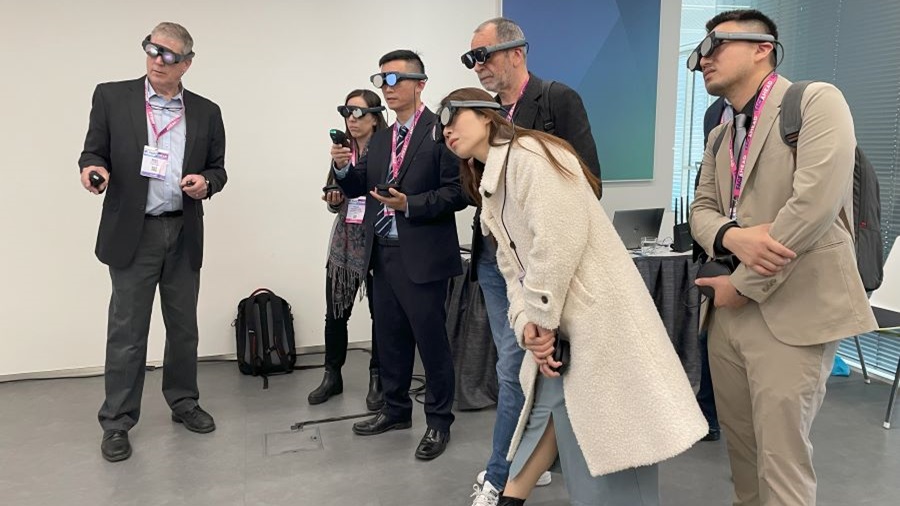
Backed by the AO’s innovation funding, two innovative clinicians are collaborating with digital technology company Brainlab and the AO Education Institute (AO EI) to develop and deploy an in-person educational platform leveraging mixed-reality technology to take the AO’s popular small group case discussions to the next level of engagement and knowledge retention at on-site courses.
The two-year project’s kickoff meeting was held during the AO Davos Courses 2023. It is driven by coinvestigators Marc Christian Metzger, MD, DMD, Edward Bradley ("Brad") Strong, MD. Metzger is a professor and vice chair of the Universitätsklinikum Freiburg's Department of Craniomaxillofacial Surgery in Germany. Strong is professor, vice chair, and division chief of the University of California Davis (UC Davis) Medical Center’s Department of Otolaryngology in Sacramento, United States, and director of the UC Davis 3D Printing and Visualization lab. Both have been long term members of the AO TC Computer Assisted and Image Guided Surgery Global Expert Committee.
“The idea for this project arose during an AO course in Tampa, United States, three years ago,” Metzger explained. “We had a very large [AO CMF] course where—among other things—companies presented their latest developments. Brainlab was represented with its Mixed Reality Viewer on the Magic Leap augmented reality device and offered the opportunity for every participant to try it out. Ultimately, the idea was then developed and discussed with other faculty members.”

“Mixed reality integrates digital content into the real world and allows AO small group case discussion participants to interact simultaneously with both physical and virtual objects.”
Marc Metzger
Mixed reality (MR), the principal investigators explained, is an umbrella term for a technology that brings together elements of both virtual reality (VR) and augmented reality (AR). VR immerses users—wearing a VR headset that replaces their real surroundings with a completely virtual environment—while AR superimposes digital imagery onto the user’s field of vision, enhancing the physical environment.
“MR encompasses both VR and AR technologies: It integrates digital content into the real world and allows AO small group case discussion participants to interact simultaneously with both physical and virtual objects,” Metzger pointed out. “MR experiences are more immersive and interactive than traditional AR because virtual objects can respond to and interact with real-world objects.”
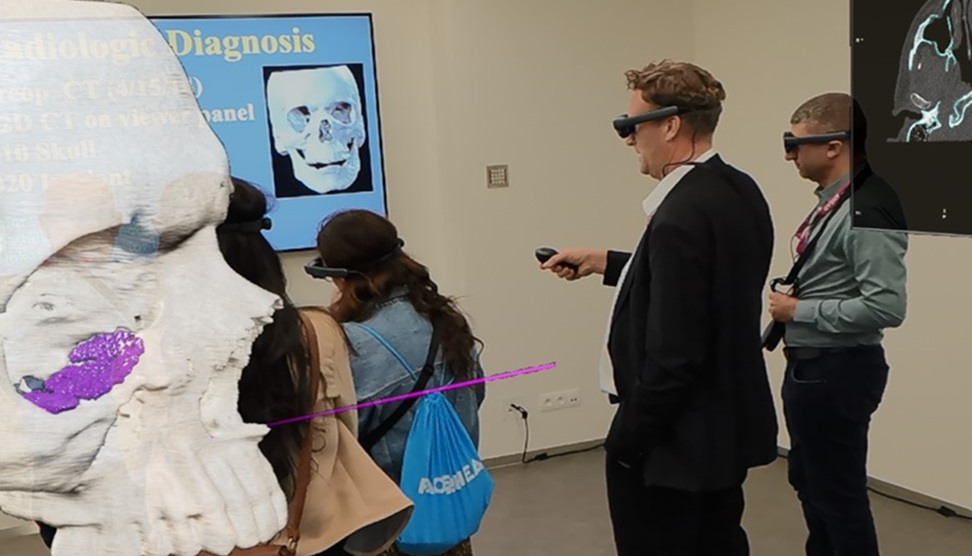
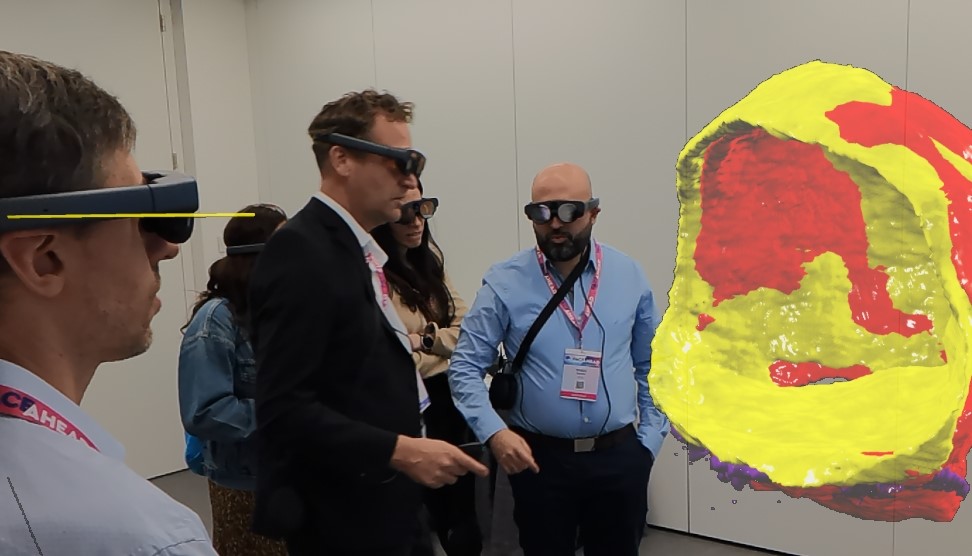
Strong noted that the AO's extended reality in-person platform (AO XR) will allow more in-depth small group case discussions about anatomy, allowing faculty and learners to actually point at, measure, and experience virtual anatomical features in greater depth.
“As part of the study associated with this project, we are studying how people are learning, whether they feel they’re learning better, or faster, for example,” he said. “We hope to publish our conclusions in the next 12–18 months.”
The AO XR project was successfully trialed at the AO CMF NA Course—Contemporary Management of Orbit and Midface Trauma near Boston, United States, and at the AO CMF FACE AHEAD summit in Prague, Czech Republic, in April 2024.

“As part of the study associated with this project, we are studying how people are learning, whether they feel they’re learning better, or faster, for example.”
Brad Strong
“Eighty-five percent of learners at both events rated the small group case discussions with MR ‘outstanding’ or ‘very valuable,’” Strong said, adding that the platform will be in the spotlight at the AO CMF Masters Course—Emerging Technologies in Orthognathic Surgery during the AO Davos Courses 2024.
Metzger and Strong emphasized that—in addition to enhancing interaction and visualization, enabling real-time collaboration among participants, overcoming resource scarcity, and increasing engagement and retention—AO XR is adaptable, customizable, and could easily be deployed across the AO’s other clinical divisions AO Trauma, AO Spine, and AO VET.
“This represents a cutting-edge approach to surgical education in training, leveraging MR technologies in innovative ways,” Metzger said. “The project pioneers the integration of these technologies—including VR and AR—into surgical education. This allows for immersive, interactive, and realistic surgical procedures and anatomical structures.”
In addition to collaborating with the AO EI and Brainlab, Metzger and Strong said their project has benefited from the expertise of Prof Florian Thieringer, codirector of the multidisciplinary 3D Print Lab at Universitätsspital Basel, Switzerland; Prof Majeed Rana, senior physician and deputy director of the Universitätsklinikum Düsseldorf 's Clinic for Oral, Maxillofacial and Facial Plastic Surgery in Germany.
You might also be interested in:
- Learning more about the AO and Brainlab partnership
- Discovering the AO's innovation funding
- Exploring the AO Education Institute's activities
- Finding AO courses that match your interests