

AO Past President Suthorn Bavonratanavech: ”The AO is truly a global association of surgeons”
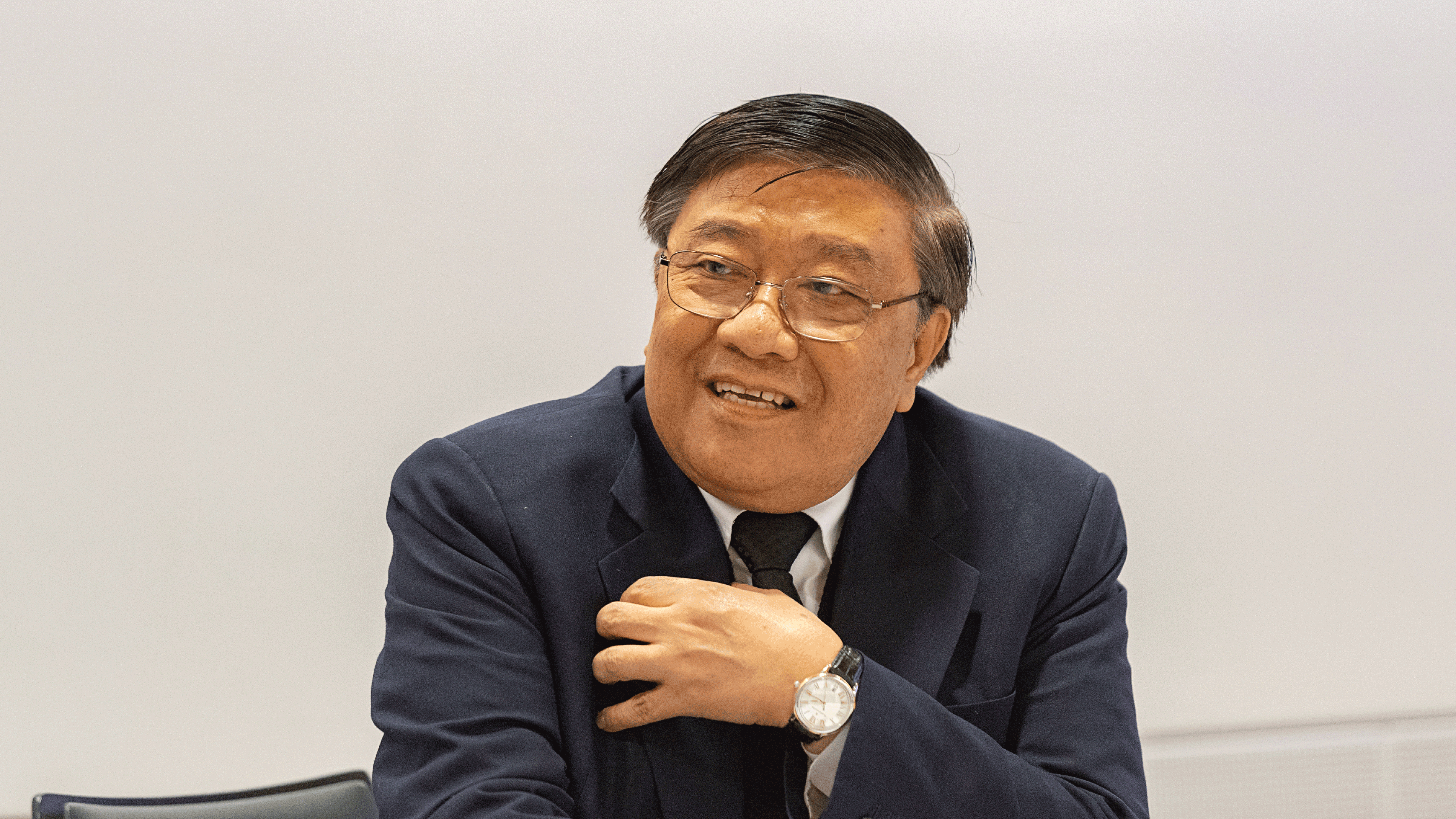
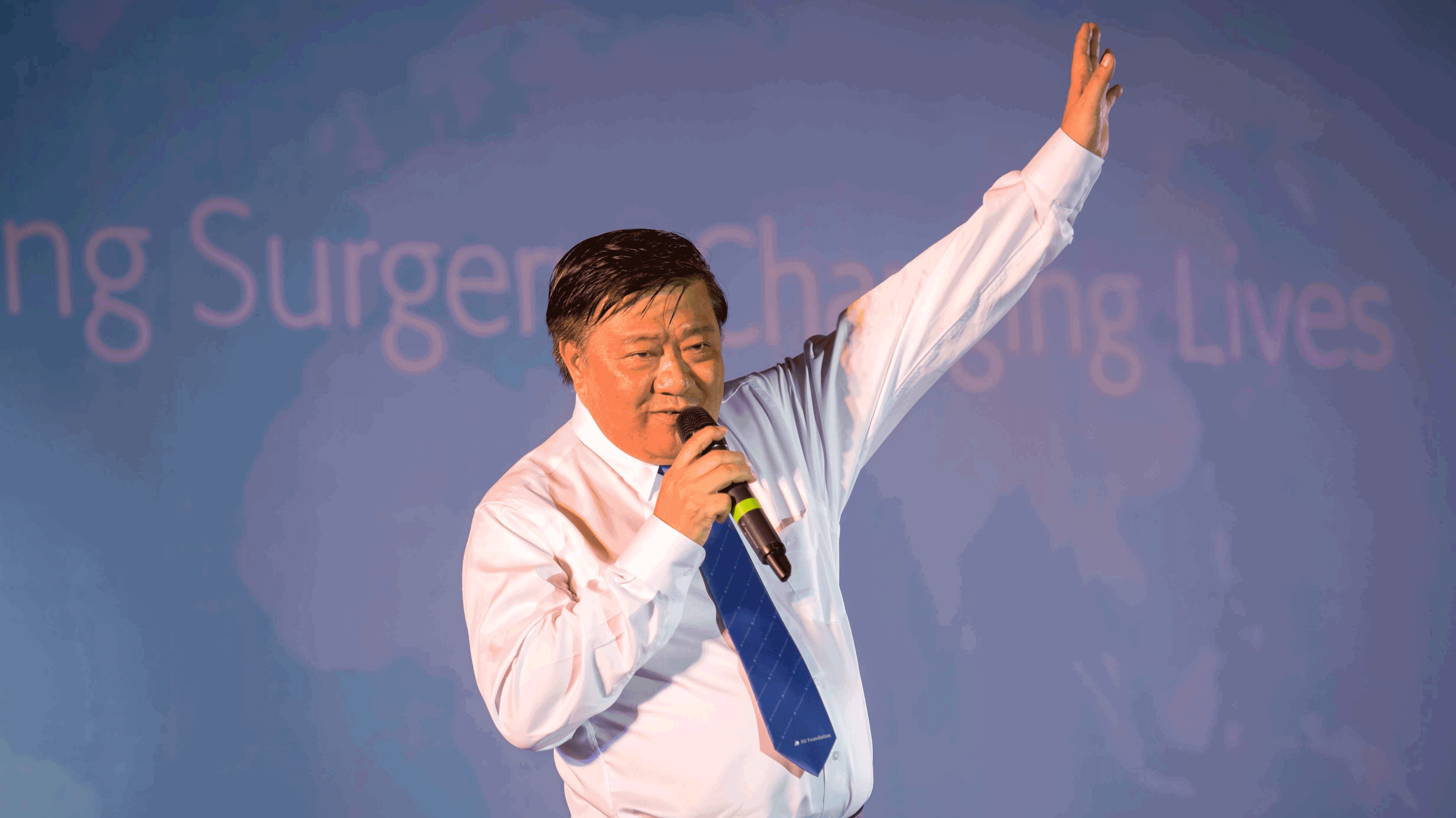
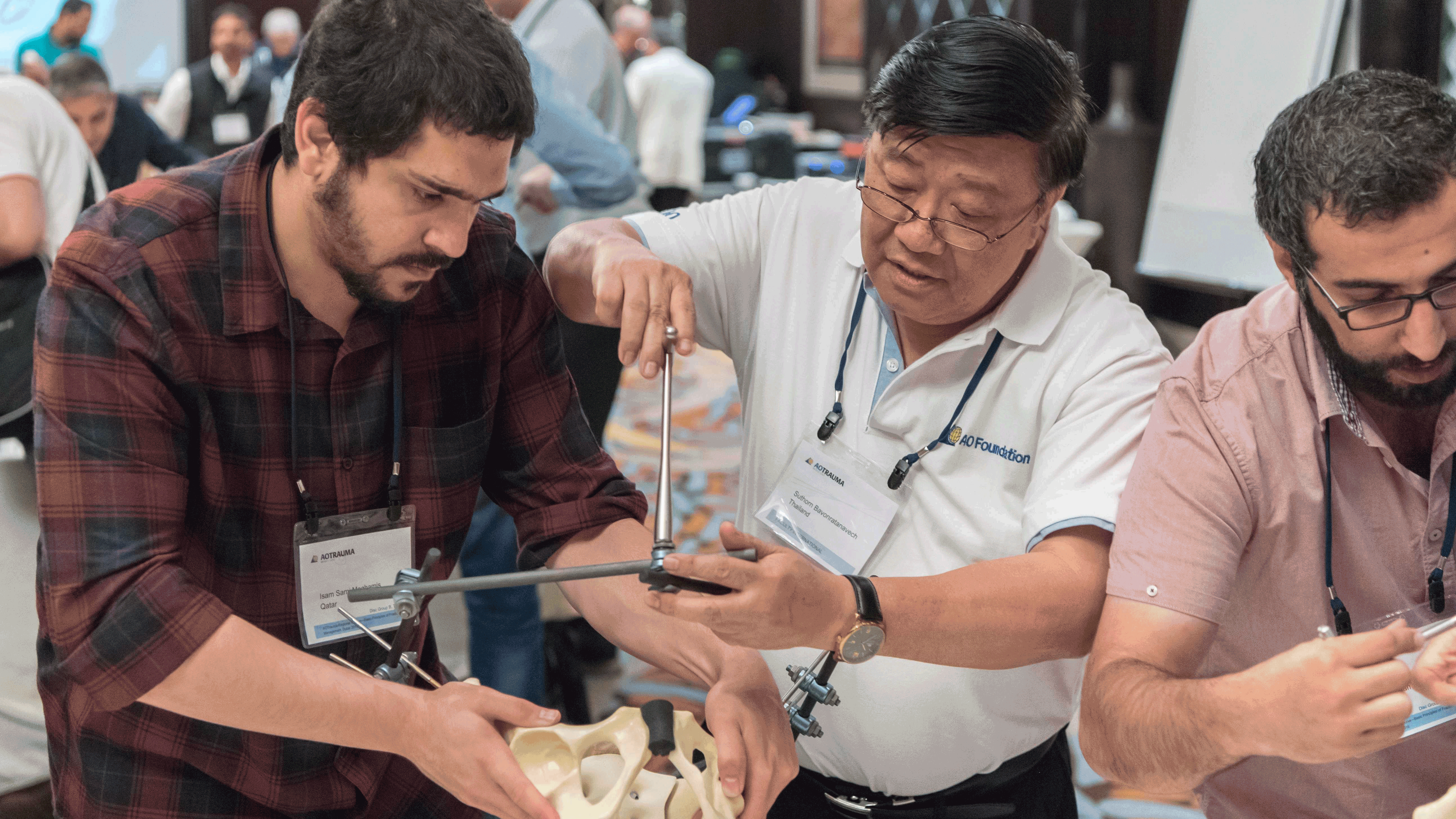
You served as AO President from 2014 to 2016. As the first Asian elected in that role, how was your experience?
First, I never had any ambition to be a candidate for this prestigious position. When I joined the AO, I did every task expected of me with great pleasure for my beloved organization. The AO founders and mentors were my role models. In 1988, Siegfried Weller proposed that I should be an AO Trustee and serve as the ambassador for the whole Asian region. In 2011, at the AO Trustees Meeting in Berlin, I was nominated as President-Elect and later served as President from 2014 to 2016. I accepted this position with immense honor, not only for myself but also for all my colleagues in Asia Pacific who have been working extensively to spread the philosophy of the AO since 1975. We were delighted that our work for the AO in the Asia Pacific region had expanded and was acknowledged by the AO Foundation. This is a good example that every surgeon from any region has a possibility to step up as a leader in this foundation. As the AO President, I considered myself a servant-leader to give support and communicate with the global network of AO surgeons. Every decision I made was for the benefit of the AO Foundation and not for personal recognition.
Your AO presidency coincided with the merger of Synthes and Johnson & Johnson (J&J).
Yes, and the future of the AO was uncertain after Synthes had merged with J&J. It was a rewarding learning experience to be at the higher decision-making level for these three years, especially with the negotiations of the new agreement between the AO Foundation and J&J. How to collaborate as partners, which at the end was to secure the future of the AO Foundation. Finally, during my presidency in 2015, the AO Foundation and J&J signed a cooperation agreement at the Trustees Meeting in Chiang Mai, Thailand.
How did you find out about the AO?
I first met Hans Willenegger—one of the five founding fathers of the AO—when he visited Bangkok in 1977 to lecture on the AO’s philosophy. I was in my last year of training, and I had no idea about the AO. The audiences were mainly chiefs of orthopedic departments and senior surgeons from numerous hospitals. I was privileged to be assigned as Willenegger’s chauffeur to drive him around the city. He persuaded me to attend the AO Davos Courses to learn about fracture treatment which I also wanted to study in-depth. It was like a dream that I had the opportunity to follow my chief to attend the AO Basic Course in Davos in 1978 at such a young age. The knowledge and the atmosphere at the courses with the enthusiastic, passionate faculty inspired me immensely. I wanted to join the AO and one day be a lecturer at the AO Davos Courses and in my country. I resolved to acquire deeper understanding of the AO Principles of Fracture Management. And I did an AO fellowship in Basel with Martin Allgöwer and Erwin Morscher in October and November 1982. After my fellowship, I attended an advanced course in Davos. Back at my hospital I started to apply these techniques to gain further proficiency before I could teach. Hans Willenegger kindly sent me the workshop instruments to organize the AO Courses in Thailand since 1985. Even now, the AO Basic Course occurs annually. In 1985, Siegfried Weller invited me to join his team as faculty and travel to different countries in Asia. I had to improve my English and collected personal cases to prepare slides for presentations. As AO Faculty, I traveled to numerous countries that I would never have had a possibility to visit. I have taught in almost every Asian country.
With the regionalization concept of Marvin Tile—the first non-Swiss AO President—I was able to establish AO East Asia in 1994, which was renamed AO Asia Pacific in 2007. I am grateful to several AO surgeons in the member countries who joined hands. In fact, AO Asia Pacific is the largest region in terms of population with more than 3.5 billion people. The concept of regionalization empowers each country to strengthen its AO education and have more trauma leaders in each country. AO education has proliferated all over Asia.
AO surgeons are volunteers and ranked among the best globally, and this certainly includes you. What achievements are you most proud of?
In 1985, when I became an AO Faculty member, my mentor, Hans Willenegger, and later Siegfried Weller gave me two important tasks: first, to prove that an Asian surgeon can operate with AO techniques just as well as the Swiss and German surgeons do; second, to be responsible for the education activity in all of Asia and not only in my own country. For the last 40 years I have never forgotten their mandate and I tried my best to spread the AO concept and teaching activities throughout the Asia Pacific region. My proudest accomplishment is having successfully contributed to promoting the AO in many countries. I support the next generation who are now trauma leaders in their countries. The same phenomenon happens internationally wherever the AO has a presence. As a teacher, I am delighted when I meet surgeons at an AO course and they walk up to me and say, 'I attended an AO course many years ago and you were the faculty and now, I am the leading AO trauma surgeon in my country.' At present, AO Trauma Asia Pacific is one of the foremost regions that organizes regional courses with human anatomical specimens every two years.
The other achievement I am proud of is the operating room personnel (ORP) education in Thailand. The first course started in 1986, and we continue organizing one to two courses each year. In 2022, we organized the 61st AO Trauma Course—Basic Principles of Fracture Management for ORP.
The AO recently celebrated its 65th Anniversary. How do you want the AO to progress?
To answer this question there are two key elements―the history and the future. For the history part, we must analyze why this organization has continued to grow and endured for 65 years since its founding in 1958. What are the core values that keep the AO alive? The AO is not just plates and screws with techniques for osteosynthesis—it has had a soul and spirit since its establishment by our founding fathers. Anyone who is a genuine AO surgeon should have commitment, dedication, and determination to contribute their knowledge and expertise for better patient outcomes. They should ask: ‘What can I give and not what can I get from the organization?’ We should serve selflessly, as our founders did, for the benefit of the AO and not for personal gain. For the future, the AO must adapt to the changing world of technology, such as education and training with simulation, the digital world of communications, and AI. There are new and different approaches to learning that can address a specific learner's needs. The AO should provide the best portfolio in medical education and offer up-to-date learning programs.
How about engaging the younger surgeons?
The key for the AO’s future triumph is to be appealing for the younger generation. However, we must preserve the AO spirit, which is the fundamental value of the AO. James Kellam, one of my mentors and AO Past President, described it as follows: Within Swiss tradition the concept of a fraternity or confederation is nothing new, nor are the values of liberty, equality, and loyalty to serve a common purpose. This special spirit is one aspect of the AO that contributes to its longstanding success. Relations among the AO founders were strongly influenced by these; and of the values, trust and credibility are possibly the most important for a professional network of surgeons working toward a specific goal: better patient care.
The AO spirit is not based on vague assumptions but on specific values that have permeated throughout the whole organization. It is one of the cornerstones on which the AO Foundation was built. The AO is a face-to-face community where members know each other personally: people talk with people, their opinions filter through, and shape the AO spirit as much as it shapes them.
What do you want to share with the next generation of AO surgeons?
I am a member of the third generation of AO surgeons. The first and second generations of AO surgeons were role models for us, we met them and worked with them. They had displayed tireless dedication and strong motivation with continuous commitment. They had taught and worked for the AO's development with true spirit. My suggestion is that we need to emphasize the role model of the AO founders to the younger generation who will join the AO. These young surgeons should be inspired to give rather than to get. This is the turning point, as the AO wants to expand to have more members, but I think that we should aim for quality not quantity.
Once you attend an AO course you will realize that our faculty is unique. You will acquire knowledge, skill, and approaches for fracture management. The AO gives you full opportunity to contribute to education, research, innovation, management, and leadership. The AO is truly a global association of surgeons, and once you join you are a friend forever.
You might also be interested in:
- Reading more AO history stories
- Learning about the AO archive and history project
- Viewing the AO image collection
- Searching our online AO library catalog